Choosing a binder · Reviewed 2 September 2026
Pokémon card binder sizes and pocket layouts
The useful number is not simply “pages”. It is pockets per side multiplied by usable card sides.
The capacity formula
Multiply pockets across by pockets down to get pockets per side. Multiply that by the number of usable sides. If a bound binder contains 20 double-sided sheets, it normally has 40 card sides.
Example: 3 × 3 pockets × 40 sides = 360 card pockets. A 4 × 3 binder with the same 20 sheets holds 480.
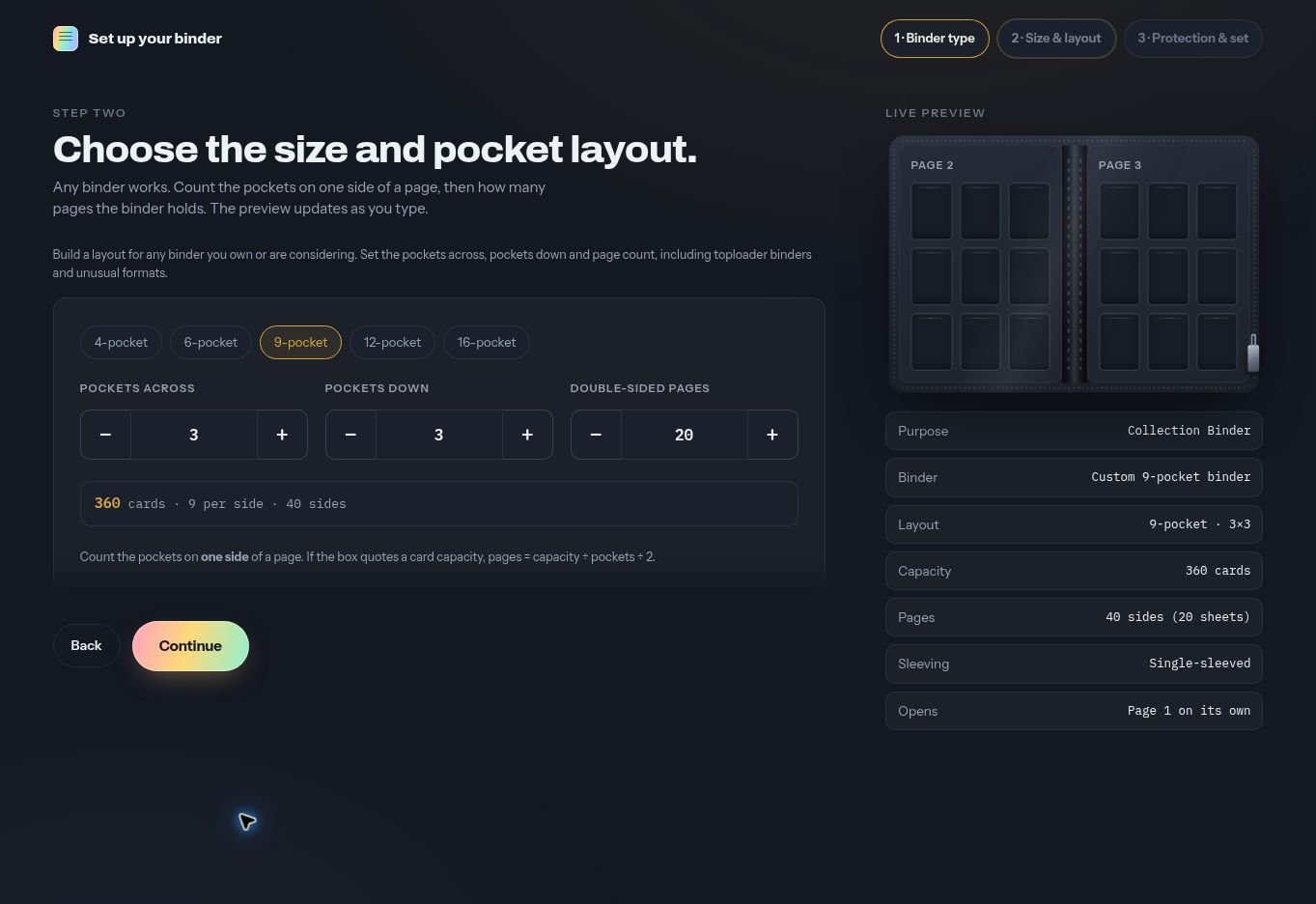
Manufacturers sometimes use “page” to mean a complete double-sided sheet and sometimes mean one visible side. Use the published total capacity as a cross-check.
What common layouts suit
- 2 × 2 (4-pocket): compact, easy to handle and good for small themed collections.
- 3 × 2 (6-pocket): a useful middle ground, especially for smaller sets or decks.
- 3 × 3 (9-pocket): the familiar trading-card layout with a natural three-card rhythm.
- 4 × 3 (12-pocket): more capacity per page and strong for large modern sets.
- 4 × 4 (16-pocket): very high capacity, but a wider and heavier spread.
Check how the binder opens
Many bound binders show page 1 opposite the inside cover, followed by pages 2 and 3 together. Others put usable pockets on the inside cover or are easier to think of as simple pairs. The first choice changes every spread after it, so set it before arranging feature pages.
Sleeves and toploaders affect the physical choice
A virtual grid can show the same count for single and double sleeves, but the real binder becomes thicker as material is added. Toploaders require purpose-made deeper and wider pockets; a standard side-loading page should not be assumed to fit them.
Consider weight as well as raw capacity. A fully loaded high-capacity binder may be less pleasant to browse than two smaller labelled binders.
Choose for the collection you will have
For a fixed set, count the complete checklist and select the smallest binder with sensible spare room. For an expanding species, artist or promo collection, choose an obvious continuation rule and more headroom. The setup wizard supports custom grids up to 6 × 6 pockets, published Vault X® ranges and separate Collection or Trade Binder purposes, so both standard and unusual binders can be tested before purchase.