Card languages · Reviewed 2 September 2026
Planning English and Japanese Pokémon card binders
English and Japanese releases do not always divide cards into the same sets or use the same rarity language. Treat each card’s language and source set as part of its identity.
The catalogues are related, not identical
A group of Japanese cards may later be distributed across one or more English products. Set names, release dates, collector numbers and rarity labels can therefore differ even when the artwork is familiar. Do not assume an English checklist is a complete Japanese checklist with translated names.
Separate-language binders are simplest
Choose Japanese when creating the binder or switch the language in the card-search panel. Expansion, set and rarity options then come from that language’s TCGdex catalogue. A saved Japanese card keeps its language identity even if you later search the English catalogue.
When Japanese is selected, Pokémon names can be typed in English or Japanese. For example, both Pikachu and ピカチュウ return Japanese Pikachu printings.
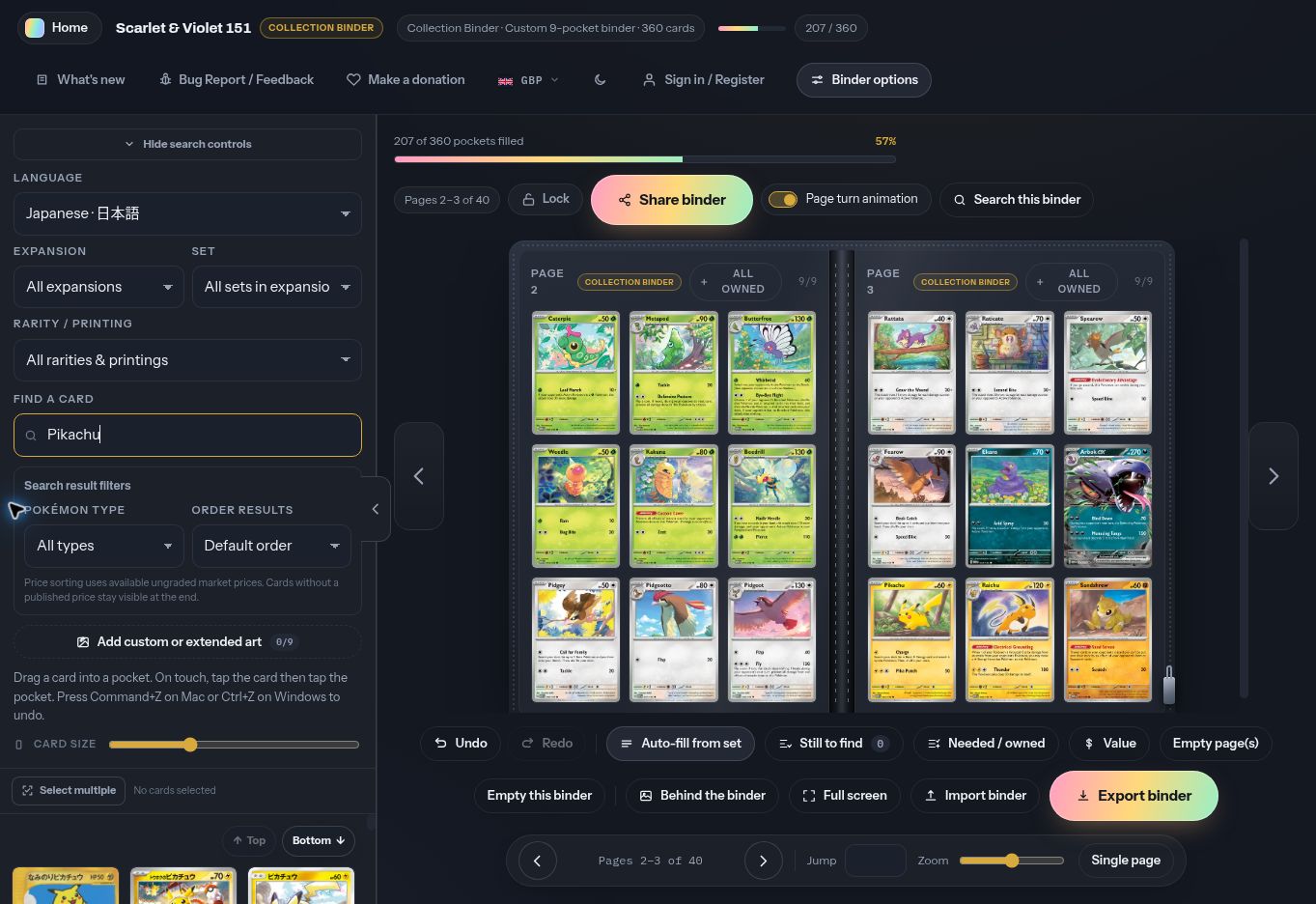
Separate binders make progress totals and missing-card lists easier to interpret. They also avoid two cards with similar artwork but different set identities appearing interchangeable.
Mixed-language collections can still be deliberate
A species, artist or favourite-artwork binder may be more enjoyable when languages are mixed. In that case, decide whether the primary order is artwork, release date, Pokémon, set or language. Add one rule for ties, such as Japanese before English for the same illustration.
The spreadsheet export includes a Language column, making mixed collections easier to audit outside the visual binder.
Read rarity filters in context
The rarity menu is populated from the active TCGdex language catalogue. A label used in one market may not have a direct one-to-one equivalent in the other. Use the set and collector number alongside rarity rather than relying on a translated rarity name alone.
Reverse-holo availability also depends on the printing information available for that language. The planner presents the records supplied by the active catalogue and does not invent a parallel printing when the source does not identify one.
Expect catalogue coverage to evolve
TCGdex is a community data source and its language completion changes as records and scans are contributed. A card can have complete metadata before a usable scan is available. The planner shows an unavailable-art placeholder instead of substituting a generic card back.
Good practice: keep the set code and collector number in a wishlist or export. Those identifiers are more reliable than an English-translated name when checking a Japanese card.